P1 dongles and optical smart meter readers compared
Want to see your home's electricity use and solar feed-in in real time? You need a small reader on your digital meter. We compare the most popular P1 dongles for the Netherlands, Belgium, Luxembourg and Switzerland, and the best optical (IR) readers for Germany, on price, connectivity, running costs and Zerofy support.
P1 dongles Optical readersP1 or optical – which reader fits your meter?
Digital electricity meters have a local customer interface that pushes live readings. Which kind your meter has depends mainly on the country and the grid operator.
P1 port (RJ12 socket)
A small phone-style socket, usually labelled "P1" (or "GP" on some Belgian meters). It is the standard in the Netherlands, Belgium and Luxembourg, and common on Swiss smart meters. Most dongles take their power straight from the port.
Compare P1 donglesOptical interface (infrared)
A small infrared window on the front of the meter, often marked "INFO". It is standard on German modern meters (moderne Messeinrichtung) and smart meter gateways. A magnetic reading head sticks onto the window.
Compare optical readers| Country | Interface and what to know |
|---|---|
| Netherlands | P1 (DSMR)In practice no activation needed. DSMR 5 meters send data every second and power the dongle; older DSMR 4/2 meters update every 10 s and often need a USB power supply. |
| Belgium | P1 (eMUCs-P1 = DSMR 5.0.2)The port is off by default in most of Belgium. Flanders: open it on mijn.fluvius.be (Poortbeheer) – takes up to 72 h. Wallonia: ORES activates it free of charge by phone, RESA via MyRESA. Brussels: Sibelga. |
| Luxembourg | P1 (encrypted, every 10 s)Every Smarty meter has a P1 port, but the data is encrypted. Request the P1 key from your grid operator (Creos via my.creos.net) and pick a dongle that can decrypt it. |
| Switzerland | P1/DSMR or M-Bus (RJ12/RJ45)The customer interface is required by law (StromVV). Ask your utility to activate it; the industry standard allows up to 10 working days. Landis+Gyr E450/E570 meters use M-Bus instead of P1 – choose a reader that supports it. |
| Germany | Optical (SML / D0)Request the 4-digit PIN from your metering operator (Messstellenbetreiber), enter it with a flashlight and set "InF" to "On" to get full-resolution data and feed-in values. |
| Austria | Mostly M-Bus/P1, some opticalAustrian smart meters usually encrypt the customer interface. Get the key from your grid operator and check that the reader supports your meter. |
| Poland | Wireless M-Bus (HAN port, encrypted)Smart meters (LZO) must have an encrypted wireless M-Bus HAN port. Tauron activates it in eLicznik within one business day; PGE Dystrybucja and Stoen on request (up to 2 months; newer Stoen meters have an encrypted P1 port). Energa uses its own USB port and Enea is only starting. No plug-and-play dongle exists yet – a CT-clamp energy meter such as the Shelly Pro 3EM works with Zerofy. |
The best P1 dongles in comparison
A P1 dongle plugs into the RJ12 port of your digital meter and sends live consumption, feed-in, and often gas readings over Wi-Fi. We compared six popular models for the Netherlands, Belgium, Luxembourg and Switzerland. The first three work directly with Zerofy.
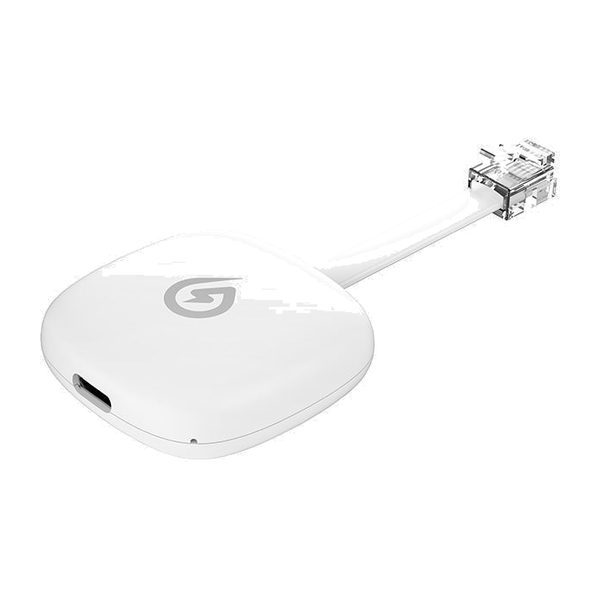
SOLARMAN P1 Meter Reader
€29.00
The cheapest P1 dongle in this comparison, sold by the Chinese inverter-logger specialist SOLARMAN (also as the Indevolt P1 dongle). Data goes to the SOLARMAN Smart app, and Zerofy picks it up from there, with no SOLARMAN inverter needed. Officially listed for Dutch meters. Belgian support is still being verified, and it does not decrypt Luxembourg Smarty meters.
- Countries
- Connection
- Wi-Fi 2.4 GHz
- Power supply
- P1 port (DSMR 5) or USB-C
- Update interval
- Cloud every 1–10 min (default 5 min)
- Running costs
- None
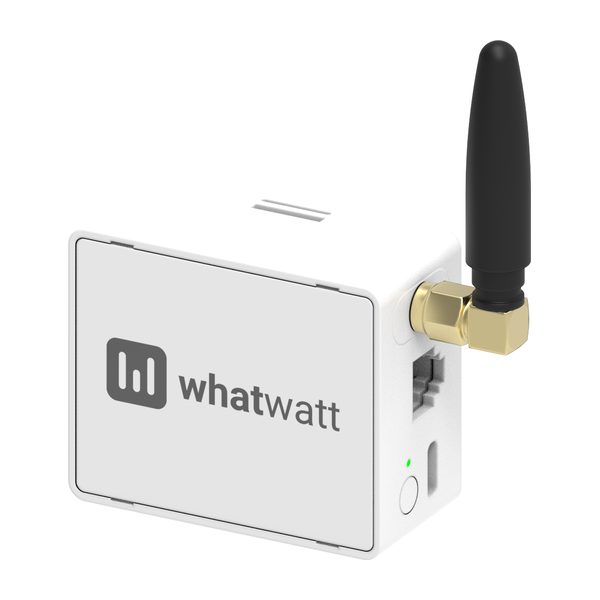
whatwatt Go
CHF 90.00 incl. 12 months of data storage
The Swiss all-rounder from Portalban (FR). It is the only reader here that handles both Swiss customer-interface flavours, P1/DSMR and the M-Bus port of Landis+Gyr E450/E570 meters, and it adds Ethernet and Modbus TCP. smart-me, Solar Manager and myStrom also read their utility-meter data through whatwatt Go. Zerofy connects to it via the whatwatt cloud.
- Countries
- Connection
- Wi-Fi (external antenna) + Ethernet
- Power supply
- Meter port or USB-C
- Update interval
- 1–10 s (depends on meter)
- Running costs
- Data storage included for 12 months
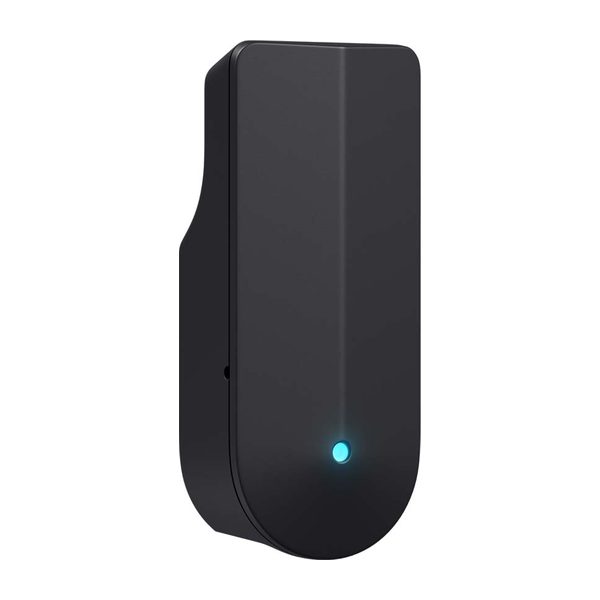
Tibber Pulse P1
€99.95 Tibber store; around €89 at retailers
Tibber's P1 dongle for the Dutch market, with a polished app and built-in load balancing for EV chargers such as Easee and Zaptec. It works without a Tibber energy contract, but then the app only keeps 24 hours of history. Zerofy reads it through the Tibber API every 15 minutes.
- Countries
- Connection
- Wi-Fi 2.4 GHz
- Power supply
- P1 port (DSMR 4+) or micro-USB
- Update interval
- 1–2 s
- Running costs
- None; full history needs a Tibber contract
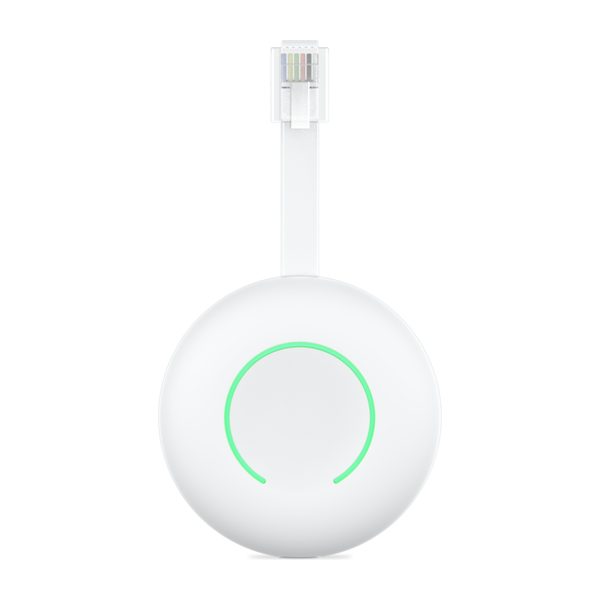
HomeWizard P1 Meter
€24.95
One of the most popular P1 meters in the Netherlands and Belgium, from Noordwijk, with more than a million households according to HomeWizard. It is cheap and has a well-documented local API. It also supports encrypted Luxembourg Smarty meters (with the P1 key) and most Swiss P1 meters, though not the Iskraemeco meters used by some Swiss utilities.
- Countries
- Connection
- Wi-Fi 2.4 GHz
- Power supply
- P1 port (DSMR 5) or USB-C
- Update interval
- 1 s
- Running costs
- None; Energy+ (€0.99/month) for history beyond 12 months
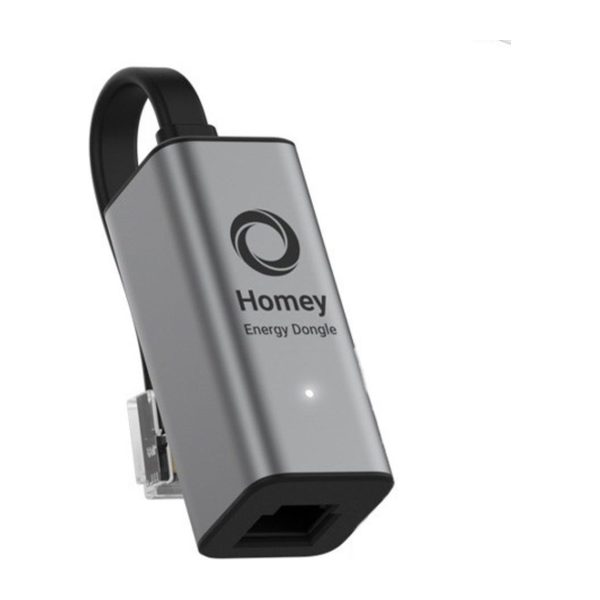
Homey Energy Dongle
€39.00
Made by Athom in Enschede (now majority-owned by LG). Its standout feature is a built-in P1 splitter, so a second device such as an EV charger can still use the port. It is best if you already run a Homey smart-home system, because it needs a Homey account.
- Countries
- Connection
- Wi-Fi 6 (2.4 GHz)
- Power supply
- P1 port (DSMR 5) or USB-C (cable incl.)
- Update interval
- Real time (meter rate)
- Running costs
- Homey account required
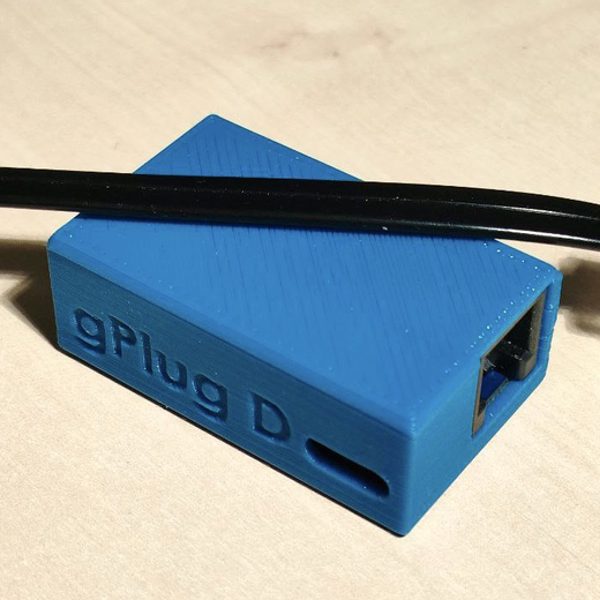
gPlug gPlugD
CHF 44.00
A compact, open Tasmota-based reader from Gantrisch Energie in Schwarzenburg (BE), listed on the Swiss utilities' smart-metering-interface.ch portal. It is fully local, with no app or cloud. Separate variants exist for Kamstrup meters (gPlugK) and for the Landis+Gyr M-Bus interface (gPlugM).
- Countries
- Connection
- Wi-Fi (Ethernet variant available)
- Power supply
- Meter port or USB-C
- Update interval
- 1–10 s (depends on meter)
- Running costs
- None
P1 dongles at a glance
| Model | Price | Countries | Connection | Update interval | Gas meter via P1 | Running costs |
|---|---|---|---|---|---|---|
| SOLARMAN P1 Meter Reader Works with Zerofy |
€29.00 | Wi-Fi 2.4 GHz | Cloud every 1–10 min (default 5 min) | None | ||
| whatwatt Go Works with Zerofy |
CHF 90.00 | Wi-Fi (external antenna) + Ethernet | 1–10 s (depends on meter) | – | Data storage included for 12 months | |
| Tibber Pulse P1 Works with Zerofy |
€99.95 | Wi-Fi 2.4 GHz | 1–2 s | – | None; full history needs a Tibber contract | |
| HomeWizard P1 Meter | €24.95 | Wi-Fi 2.4 GHz | 1 s | None; Energy+ (€0.99/month) for history beyond 12 months | ||
| Homey Energy Dongle | €39.00 | Wi-Fi 6 (2.4 GHz) | Real time (meter rate) | Homey account required | ||
| gPlug gPlugD | CHF 44.00 | Wi-Fi (Ethernet variant available) | 1–10 s (depends on meter) | – | None |
Prices in EUR or CHF incl. VAT from the manufacturer's shop, checked October 2026. Retail prices vary; we earn no commission on any of these products.
The best optical (IR) readers in comparison
An optical reader, or IR reading head, attaches magnetically to the infrared interface of your meter and reads consumption and feed-in. These five are the most popular models for German meters. The first three work directly with Zerofy.
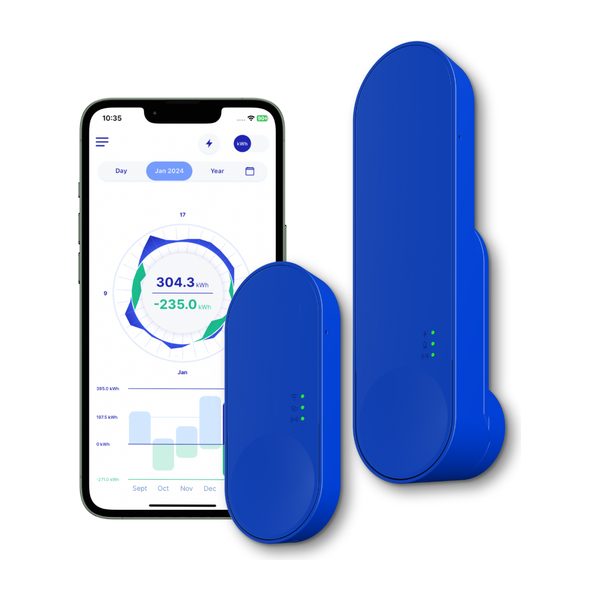
IOmeter Core + Bridge
€79.90 RRP €119.90
The Berlin-made reader for meters in the basement. The battery-powered Core sits on the meter and sends data over its own 868 MHz radio to a Bridge in the living area, up to 50 metres or about three floors away. You need neither Wi-Fi nor a socket at the meter. Not usable in Austria.
- Countries
- Connection
- 868 MHz radio to bridge (Wi-Fi), up to 50 m
- Power supply
- 2× AA (approx. 1.5 years) or USB-C
- Update interval
- 10 s in live mode
- Running costs
- None; IOmeter Plus optional (€4.99/month)
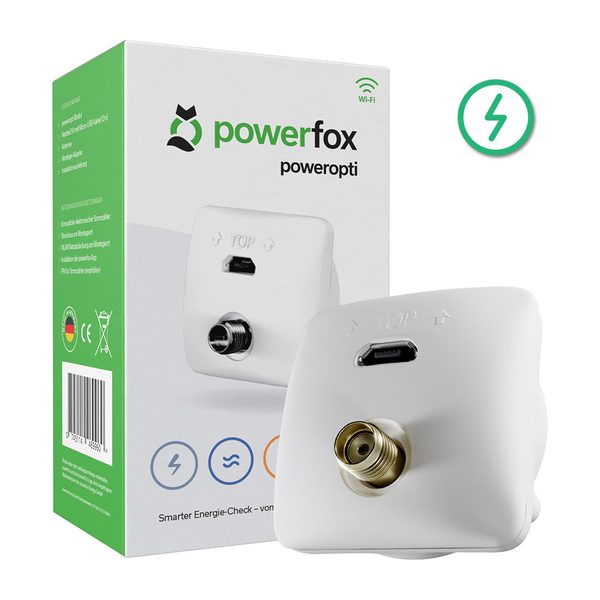
powerfox poweropti
€69.90
One of the best-known optical readers in Germany, from powerfox in Berlin, available with an LED or an IR diode for different meter types. It is a single device with Wi-Fi at the meter. The same platform also reads gas, water and heat meters. Real-time values and API access need the PRO subscription.
- Countries
- Connection
- Wi-Fi at the meter
- Power supply
- Micro-USB (socket at meter)
- Update interval
- 15 min (free) / 6 s (PRO)
- Running costs
- PRO €1.99/month for real-time data and API
Tibber Pulse IR
€129.95 €99.95 with a Tibber contract
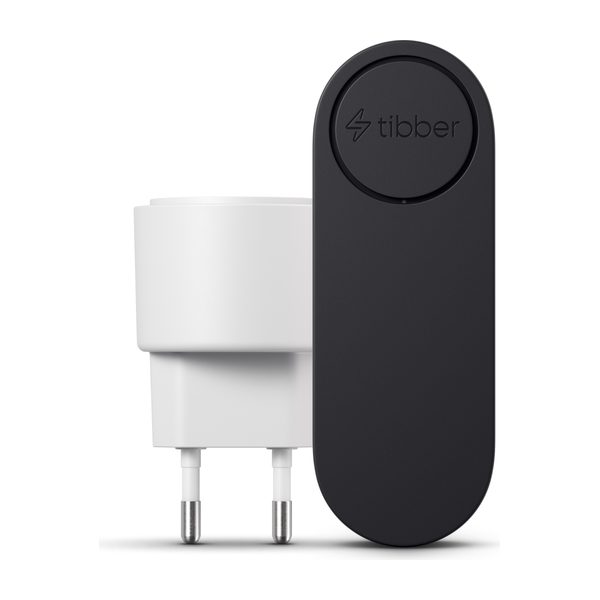
Tibber's battery-powered reading head for German meters. It sends data by radio to a bridge plugged into a socket, so you need no Wi-Fi at the meter. Live data refreshes every 2 seconds. It is €30 cheaper with a Tibber electricity contract. Zerofy reads it through the Tibber API every 15 minutes.
- Countries
- Connection
- Radio to bridge (Wi-Fi in a socket)
- Power supply
- 2× AA batteries
- Update interval
- 2 s (power)
- Running costs
- None; full history needs a Tibber contract
everHome EcoTracker IR
€99.00 RRP; around €74 at retailers
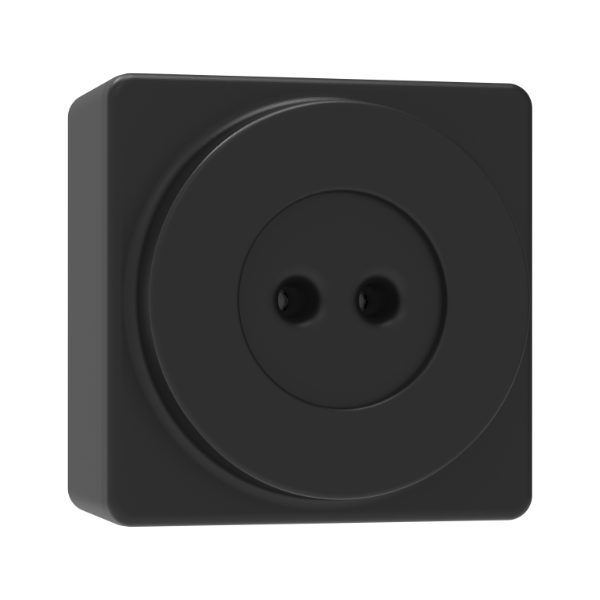
From everHome in Coesfeld, and a popular reader for balcony solar batteries. Zendure, EcoFlow Stream and Anker SOLIX use its readings to match battery output to household consumption. It has an open local JSON API but needs Wi-Fi and a socket at the meter.
- Countries
- Connection
- Wi-Fi at the meter
- Power supply
- USB-C (power adapter incl.)
- Update interval
- approx. 1 s (local API)
- Running costs
- None
bitShake SmartMeterReader Air
€39.90
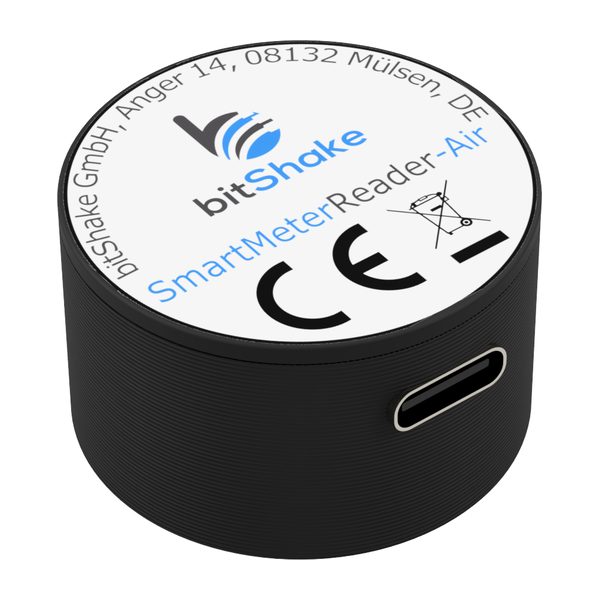
The popular do-it-yourself option from bitShake in Mülsen, Saxony. It is an ESP32 IR read/write head running Tasmota, with ready-made scripts for most meter manufacturers. It is cheap and fully local, but expect some setup work with scripts and MQTT.
- Countries
- Connection
- Wi-Fi at the meter
- Power supply
- USB-C (power adapter not incl.)
- Update interval
- approx. 1 s (meter rate)
- Running costs
- None
Optical readers at a glance
| Model | Price | Countries | Connection | Update interval | Running costs |
|---|---|---|---|---|---|
| IOmeter Core + Bridge Works with Zerofy |
€79.90 | 868 MHz radio to bridge (Wi-Fi), up to 50 m | 10 s in live mode | None; IOmeter Plus optional (€4.99/month) | |
| powerfox poweropti Works with Zerofy |
€69.90 | Wi-Fi at the meter | 15 min (free) / 6 s (PRO) | PRO €1.99/month for real-time data and API | |
| Tibber Pulse IR Works with Zerofy |
€129.95 | Radio to bridge (Wi-Fi in a socket) | 2 s (power) | None; full history needs a Tibber contract | |
| everHome EcoTracker IR | €99.00 | Wi-Fi at the meter | approx. 1 s (local API) | None | |
| bitShake SmartMeterReader Air | €39.90 | Wi-Fi at the meter | approx. 1 s (meter rate) | None |
Prices in EUR or CHF incl. VAT from the manufacturer's shop, checked October 2026. Retail prices vary; we earn no commission on any of these products.
Turn your meter data into savings with Zerofy
A meter reader shows you what is happening. Zerofy acts on it. Connect your SOLARMAN P1, whatwatt Go, Tibber Pulse, IOmeter or powerfox reader, and the Zerofy app combines your meter data with your solar inverter, battery, EV charger and heat pump.
- Track grid consumption, feed-in and self-consumption in one app
- Charge your EV and run your heat pump on surplus solar or cheap dynamic tariffs
- Steer balcony batteries, smart plugs and switches automatically with Autopilot
Frequently asked questions
What is a P1 port?
The P1 port is a standardised customer interface on digital electricity meters, an RJ12 socket that pushes a data telegram with your current consumption, feed-in and meter readings. It was defined in the Dutch DSMR standard. DSMR 5 sends a telegram every second and supplies 5 V at up to 250 mA, so most dongles need no extra power. Belgium (eMUCs-P1) and Luxembourg use the same physical interface, and many Swiss meters offer P1 as well.
How do I activate the P1 port in Belgium?
In Flanders, log in to mijn.fluvius.be, open Poortbeheer and request the opening of the port. You need your eID or itsme, and activation takes up to 72 hours. A small triangle above "P1" or "GP" on the meter display shows that the port is active. In Wallonia, ORES activates the port free of charge by phone (078/15.78.01), and RESA customers can activate it in MyRESA. In Brussels, contact Sibelga. Fluvius meters also pass on gas and water readings every 5 minutes.
How do I activate the customer interface on my Swiss smart meter?
Swiss grid operators must provide a customer interface on every smart meter (StromVV), but it is usually switched off at delivery. Ask your utility to activate it, for example via the myEKZ or my.bkw.ch customer portal or by e-mail. The industry standard (VSE) allows up to 10 working days. Depending on the meter, the port speaks P1/DSMR or M-Bus (Landis+Gyr E450/E570), and some utilities, such as BKW and CKW with Kamstrup meters, hand out an encryption key. whatwatt Go and gPlug are designed for these Swiss variants.
Do I need Wi-Fi at my meter?
Most dongles connect directly to your Wi-Fi, so the signal has to reach the meter cupboard. If your meter is in a basement, readers with their own radio link and a bridge in the living area, such as IOmeter (868 MHz, up to 50 m) and Tibber Pulse IR, are the easier choice. whatwatt Go and the gPlugD-E can also be connected by Ethernet cable.
How do optical readers work, and why do I need a PIN?
German modern meters push SML data through an infrared window every second, but only a reduced data set until you unlock them. Request the 4-digit PIN from your metering operator (Messstellenbetreiber, often the local grid operator), enter it by flashing a torch at the light sensor, and set "InF" to "On". You then get full-resolution readings and live power, including feed-in. Wrong attempts never lock the meter.
Can I read my gas meter with a P1 dongle?
In the Netherlands and Flanders, the gas meter sends its readings to the electricity meter, which repeats them on the P1 port. DSMR 5 meters update gas every 5 minutes, DSMR 4 meters every hour. HomeWizard, SOLARMAN and Homey show these readings. Optical readers only see the electricity meter.
How can I read my smart meter in real time in Poland?
Polish smart meters (LZO) must by law offer an encrypted wireless M-Bus HAN port (868 MHz), but none of the dongles above supports it. Tauron customers can activate the HAN port and download the key in eLicznik, usually within one business day. PGE Dystrybucja and Stoen Operator enable it on request within up to two months, and newer Stoen meters also have an encrypted P1 port. Energa uses its own USB port with no approved devices yet, and Enea is only starting with new meters. Receiving wM-Bus data currently takes a DIY receiver (for example ESPHome with wmbusmeters). The optical port of these meters is blocked by the operators. The simplest option is a CT-clamp energy meter fitted in the fuse box by an electrician, such as the Shelly Pro 3EM, which works with Zerofy. Operator portals like eLicznik or Mój Licznik only show the previous day's data.
Which smart meter readers work with Zerofy?
Zerofy supports SOLARMAN P1, whatwatt Go, Tibber Pulse (P1 and IR), IOmeter and powerfox poweropti. Zerofy also connects to smart-me, Shelly energy meters (such as the Shelly Pro 3EM) and many solar inverters with their own meters. The setup guide for each reader is linked from its product card above.
Which reader should I buy?
In the Netherlands or Belgium: the SOLARMAN P1 is the cheapest way to get your meter into Zerofy. In Switzerland: whatwatt Go covers both P1 and M-Bus meters and connects to Zerofy. In Germany: IOmeter if your meter is far from Wi-Fi, otherwise powerfox poweropti. If you are already a Tibber customer, the Tibber Pulse is a convenient choice in both countries. In Poland: a Shelly Pro 3EM CT-clamp meter in the fuse box, which works with any meter and with Zerofy.
Product names and trademarks belong to their owners. Specifications come from the manufacturers' websites and data sheets (October 2026) and can change. Check compatibility with your meter before buying.